Local female entrepreneurs share their experience and advice at International Women’s Day event
March 23, 2026, 11:53 am
Kara Kinna
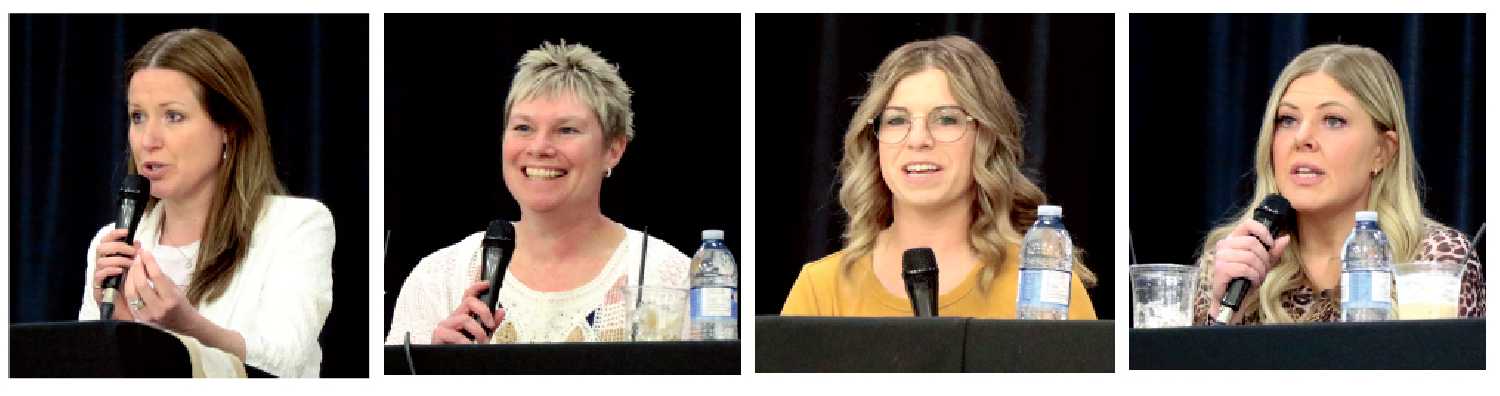

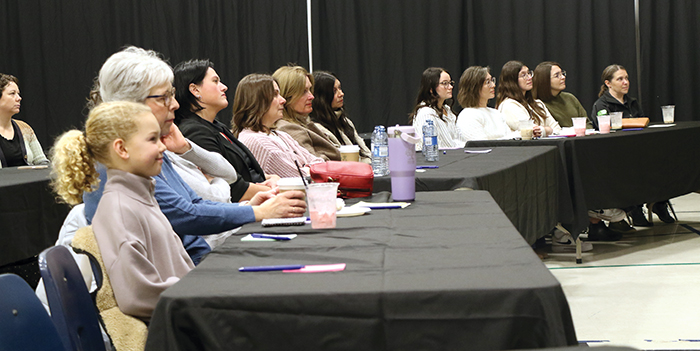
Female entrepreneurs in the Moosomin area got a chance to connect and share advice at an International Women’s Day event hosted by Women Entrepreneurs of Saskatchewan (WESK) on March 12 in Moosomin.
The even featured four panelists who own local businesses—Kari Kosior from Kari’s Kloset, Kari Meyers from Kari’s Pharmacy, Alyssa Jeannot from Jeannot Electric, and Nicole Campbell from Yorkton Concrete. Danielle Rhodes with Broadhead Electric in Moosomin, and Chelsea Stewart from House of Hearing in Esterhazy, hosted the event on behalf of WESK.
Rhodes asked each of the panelists a series of questions over the course of the evening so that they could share their advice, then questions were turned over to the floor.
Following are some of the questions that were asked and answered that evening:
What does leadership look like for you?
“Maybe this moment right now,” said Alyssa Jeannot. “Just being chosen to speak tonight was a little bit of a surprise for me, being able to give advice to women in business in Mooomin. I go to work every day and do my job, and I show up and make decisions, and I just hope that I’m helping more people that I’m hurting. And I guess just sitting here tonight is that moment for me where I realized that maybe what I’m doing is working.”
“What I immediately thought about when asked this question, was not when my voice mattered, but when my voice didn’t matter,” said Kari Meyers.
Myers said she used to work at a corporate pharmacy that had 250 stores, and by starting her own pharmacy, it gave her more options to support her community.
“Living in a small community, especially the community of Moosomin, where Moosomin is so much about supporting local and shopping local . . . that really got me thinking, how can I change so that I can support Moosomin because Moosomin has supported me. That was one of the big reasons that I left working for that corporation to open my own business and do things on my own so that I can choose to be local and support local.”
Kari Kosior said, for her, it was when other store owners around the country who followed her on social media reached out to her for advice during tough times.
“They felt comfortable to reach out to me when times were a little tough for their business, and that meant a lot,” she said. “That just made me realize that the experiences I’ve gained from running my own store, the wins and the mistakes, could actually help someone else navigate their business. So that was the moment I understood that leadership isn’t just about what happens inside your business, but also about how willing you are to share what you learned with others.”
Share a moment when something difficult shaped you into a strong leader?
“When you’re in the middle of running a business, you don’t stop and label moments that make you a strong leader,” said Kari Kosior. “You’re usually just trying to solve the problem right in front of you, but what I realized over time is that every challenge forces you to adapt. Retail, especially, is an industry where things are constantly changing, customers, habits, inventory risks, economic shifts. Each time something didn’t go the way I expected, it pushed me to listen more closely to my customers, adjust quickly and stay open to learning. Looking back, those moments didn’t just make the business stronger, they made me more resilient as a leader, and it’s good to be resilient.”
Nicole Campbell said when their company was extended financially because of non payment on a very large job, it forced her to become a stronger person.
“I learned the hard way that trying to be a people pleaser doesn’t always work out in my favor,” she said. “And so I’ve switched to a bit more of a firm but fair approach, which isn’t usually my MOI when I want people to like me, but then that’s one of the lessons that I’ve learned, and I think it has shaped me to be a better leader in my business. I have found, actually now, that people treat me better that way when I’m just firm but fair, rather than trying to be nice all the time.”
Many women struggle with imposter syndrome. You question whether you belong in the job or the business that you’re pursuing. Have you experienced that? And how did you push through it?
“I think imposter syndrome is something that every leader quietly experiences, whether they want to admit it or not,” said Alyssa Jeannot.
“There have definitely been moments in our business where I’ve questioned if I was the right person making decisions, especially the financial ones that make a difference, and my husband assures me that if I hadn’t made the hard decisions, we’d still be operating out of a truck in our garage.
“So we are doing something right, but I realized that this feeling doesn’t mean you don’t belong. It usually means that you care deeply about what you’re doing.
“What helped me move past it was shifting my focus away from proving myself and toward serving our team and our customers. When your goal becomes supporting the people around you and building something meaningful together, the question of whether you belong starts to mean a lot less. I learned that the leaders that keep learning and growing are often the ones who feel the imposter syndrome the most. I like to remind myself that the reason I’m feeling like an imposter is because I care.”
“This question, at first I was like, that’s not me. I don’t have imposter syndrome. I’m solid, I’m confident. I know where I’m at. I’m good,” said Kari Myers. “And I thought about it for a couple of days, and I thought, maybe not so much, because when I first opened the store, I put an ad online for staff because I knew that I couldn’t do it all by myself, and I had 35 people reach out. And then we started doing interviews, and we had some really good applicants, it was very hard to choose who to hire. I’m not sure how many of you have been in the store, but my stuff were amazing, and I honestly thought I really lucked out, but maybe I didn’t luck out. Maybe people wanted to work for me, because—I don’t know—I’m nice. And so I do struggle with that, and I didn’t even consider thinking about it until you gave that question to me.”
“I don’t really, honestly ever question if I belong in certain spaces, but what I do find myself doing is I often minimize the role in the success of our business, and I often attribute our success to things like good luck or timing or the ability and skill set of my team,” said Nicole Campbell. “My team is great, and they have amazing abilities and skill sets, but I’m always fearful that if I attribute any success, or too much success to myself, that I’ll be seen as not humble or ungrateful, and I always want to be viewed as being humble and grateful, and so I probably check myself a lot more than I maybe need to about that.”
“There’s a lot of pressure as a business owner to do what everyone else is doing online. So certain types of reels, trends and marketing styles, I tried leaning into some of those things. I even outsourced it. I had a girl come in for social media,” says Kari Kosior. “But it didn’t feel natural to my brand. So at one point, I had to step back and remind myself why I started my business in the first place. I built it from nothing around something I genuinely love. So I decided that if something doesn’t feel authentic to our brand or our customers, it’s okay to let it go, and that’s what I did.
“Once I stopped trying to keep up with everything and focus on what actually fits my business and our customers, I started to see better growth. My sales actually soared.”
If there is a woman sitting in this room tonight who is standing at the edge of something—a new opportunity, a big decision, a dream she’s been afraid to pursue—what would you want her to know tonight?
“I think nothing good comes from not taking risks at the end of the day,” said Alyssa Jeannot. “So go for it. Good things happen. And it usually happens when it feels like you’re making a decision that is risky, but I always find things usually work out if you’re willing to work hard and take some risks. So if you’re taking a risk, just be ready to work your butt off to make sure it happens.”
“I think that if you’re contemplating a big decision, a big change in your life, if you’re contemplating it, it’s probably the right thing to do,” said Kari Meyers. “It hasn’t been very long since I’ve made a huge change, and it has been worth every second. It was hard and terrifying and there was tears, and there still maybe is sometimes tears, but it was totally worth it.
“So if you’re thinking about something, just do it. Just start talking to your people, to your support system. They’re there for a reason, and everybody should have a good support system. If you don’t, find it, because it’s worth it.”
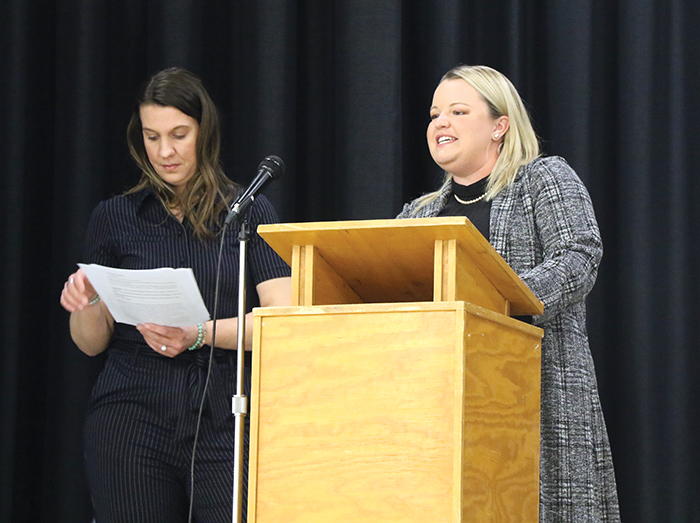 Danielle Rhodes with Broadhead Electric in Moosomin, right, and Chelsea Stewart with House of Hearing in Esterhazy, left, were the hosts on behalf of WESK for the event.
“I think as women, we over think everything, and when you’re making a decision, you think of all the worst possible outcomes in your head, and most of those are never going to happen,” said Nicole Campbell. “So my advice would be—I’ve seen this meme—and it says ‘my gut, she might hang over my pants a little bit, but she’s usually not wrong.’ So go with that.”
“I really, truly believe in timing, and what’s meant to be, it’s going to land, everything’s going to fall into place,” said Kari Kosior. “You just have to pay attention to that gut feeling. The days can be long and tiring, but waking up excited about what you’re building makes those tiring moments worth it, because you’re building something you truly believe in. And then those long days stop feeling like sacrifice and start feeling like purpose. And then, you know what, listen to the song ‘Til You Can’t’ by Cody Johnson, because that song, you’ll just listen to it, and you’ll do it. Go for it!”
What does women supporting women look like in real life and how can we do a better job of lifting each other up?
“I think that one of the most important ways that we can lift women up is when you meet a woman and they own their own business, and you learn about what they do. We can’t all be in the same room at the same time. And so when you are somewhere and somebody’s talking about something, and you’re like, ‘Oh, I know that lady. She would be a great fit, or her business would be a great fit,’ open up that door for her,” said Nicole Campbell. “Talk about her, and make those introductions in the rooms that we can’t all be in. And I think that’s the best way that we can support women in business.”
“Women are competitive,” said Alyssa Jeannot. “So we tend to eat each other up when we can. I think the biggest thing we need to do is to be mentors and collaborate and be intentional about opening doors for each other. I was listening to a gal the other day that said, it’s weird that every woman that’s in a high position of authority has been put there by a man. It’s typically not the women that put them there. It’s usually a man that saw the potential and promoted this particular person.
“A good example is Jessica Campbell from down the road. It wasn’t a lady that said, ‘Hey, you’d make a really great NHL coach. You should come coach.’ It was Dan Bylsma that saw her work and respected it and said, ‘I’m going to the NHL and you’re going to come with me.’
“So I think before we can grow as women, we just need to support each other and not eat our young. It’s not cool anymore. If we want to see more women succeed, we have to move away from the scarcity mind set and recognize that we succeed together.
“It starts earlier in life as well. We need to teach our daughters to respect each other and to be good teammates and leaders, but more importantly, how to support each other and with honesty. And play sports— all the sports. There’s research showing that the connection between girls’ participation in sports and leadership later in life is incredibly strong.”
“I think, as women we often hear compliments about other women. And it’s so easy just to listen to it and be like, ‘Oh yeah, that’s cool,’ but it’s really important to pass it along,” said Kari Meyers. “For example, I took a phone call yesterday, and the person on the phone asked me what my other pharmacist’s name was, and he says, ‘you know, she’s deadly.’ So the first thing I did was turn around and told Karla that. It’s the most amazing compliment, right? It’s just two words, but if you know her, she is! I think it’s important, because I hear compliments about other women, and if I see that person, I’ll make sure to pass it along, because it feels good to hear something good about yourself. And I think that lifts women up huge. And I don’t think that we pass it along enough.”
“Just cheer each other on,” said Kari Kosior. “In the store, if somebody’s looking for something else, whatever business it might be from, I tell them go to that store, then I try to talk about the owner, or tell them about the woman who manages it. A perfect example is a friend of mine who’s a massage therapist, who I don’t go to because I had a massage therapist before she got into the business. But I often will talk about her or recommend her. Or when I do see her, I always stop and check in, and not just catch up about the kids, but also ask ‘how’s work, how’s business, how’s managing, how’s juggling.’
“You never know when somebody might be having a vulnerable moment, and maybe you need to open up when things maybe aren’t great or maybe things are great, but either way, it’s just cheering each other on. The open door communication—having that with other women that are in business—is important.” Tweet












-SM.jpg)







 sm.jpg)