Moe talks about the trade deal with China
‘Trade is still about relationships’
January 26, 2026, 9:14 am
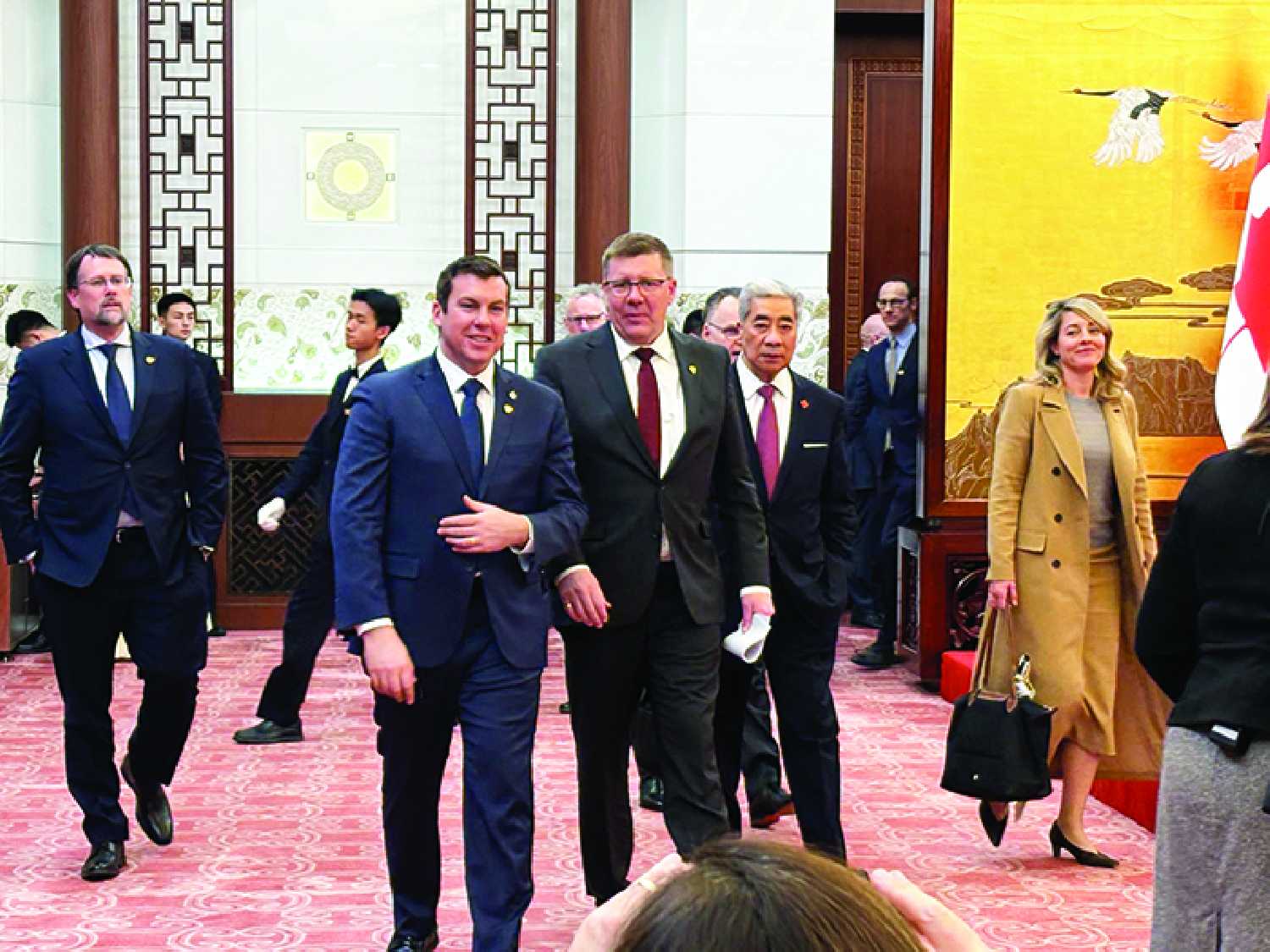

The World-Spectator spoke with Premier Scott Moe on Friday about his trip to China with Prime Minister Mark Carney in which a trade deal was brokered that will see China lower its tariffs on canola seed. China plans to lower tariffs on canola seed by March 1 to a combined rate of about 15 per cent—a drop from current combined tariff levels of 84 per cent. China is a $4 billion canola seed market for Canada. In exchange, Canada will slash tariffs on Chinese electric vehicles. Following is the interview with the premier:
Explain the groundwork and background work that went into making this deal possible. What work, what discussions, what previous trips helped make it possible, with respect to the agreements with China?
I think first and foremost, where we got to today, which is really a restoration of agricultural trade with China. It’s not really anything new. It’s a restoration of where we were a year and two and three years ago. But it does show that international engagement with our trading partners in person certainly does matter, as it provides you with the relationships, and trade is still about relationships between people and the contacts, to be able to get in front of those people when things get bumpy. Now you can’t always fix it right away. However you are in the right room speaking to the right people.
So I would say that point one is ongoing international engagement does certainly matter when things get bumpy, and we are very bumpy around the world today with multiple countries.
Second to that, specific to working towards the agreement to restore trade—and there’s some MOU’s—memorandum of understandings to expand on that trade, and I’m quite excited about that as well. But it really started in September, and the change in tone and engagement started in September when I had went to China, the first premier in six years to be on the ground in China.
Kody Blois, the Parliamentary Secretary to the Prime Minister, went with me. We were able to have the appropriate meetings with the actual organizations in government that were involved in tariffs, and thereby would be involved in removing those tariffs, and those meetings to that point were not happening with those organizations. And so in September, it really marked a change in the tone and a change in the conversations—who was having the conversations the people who matter, as opposed to just people.
And then that intensified over the next number of months, from September until ultimately we got to an agreement just this past week.
Kody Blois was very much the continuity in those negotiations, whether it was a minister, whether it was a prime minister meeting with President Xi on the sidelines, or Premier Li in New York, Kody very much was at the forefront of that effort.
So that is my second point. I’d say September was a pivot point using the contacts and the relationships that Saskatchewan have, and really lending that relationship to the federal government, to much of their credit. They engaged, and engaged heartily from that point on.
Last but not least, I would say—and this really is noticed—when I went to China, most recently with the Prime Minister, there was a significant delegation there. Kody Blois was there, and he was a continuum throughout the negotiations. But there was five or six federal ministers as well, and that’s noticed, that relationship, that type of priority.
So it was a number of things I think that came to it, but that’s a little bit of the back story and some of the history on how we got to an agreement that really restores our agricultural trade.
But there’s some memorandum of understandings that I think open up some opportunities in the energy sector, in the forestry sector, and ironically, I think, in the longer term, in the manufacturing and auto sector as well.
So if I’m hearing you right, you’re saying that when you go into these negotiations, having the right people there, having an actual relationship with these people really is important then.
It certainly does. Our international relationship under our previous Prime Minister just was not a priority, and certainly getting to points of agreement with respect to trade specifically, never seemed to be a priority.
That seems to be shifting with Prime Minister Carney, and that’s a welcome shift, from my perspective, to put a priority on Canada’s credibility on the international stage.
We’ve always believed that to be the case, and we’ve always engaged as a province through our parental trade offices and various missions that we had, and we’re happy that we did have that relationship with China and were able to really breathe some ambition into the trade relationship and the trade agreement that we got to between Canada and China.
I’ve always said, it isn’t going to be any provincial Premier, myself included, that stands up with President Xi or Premier Li and China, or any other international leader and says, ‘listen, we have a trade agreement between a province and a nation.’ That’s not how it works.
They’re always between nations and nations, and so we need that ambition and that priority from the federal government. We haven’t had it for a decade, and I was pleased to see the results of it and the prioritization of it by Prime Minister Carney.
What were your expectations going into this trip? Were you fairly confident, then, going on this mission that China would agree to lower tariffs based on some of the groundwork that was laid previously?
I knew we were close, and I’m always hopeful, however, I’m always cautious as negotiations literally do happen, and this isn’t this isn’t any different than other times we’ve had to work with tariffs, or monetary tariffs, or non financial tariffs, with countries like China and India and others. The negotiations happen literally to the very last minute.
And so I knew we were close, because we’ve been part of the conversation and discussions all along. But I was pleased in where it ended, where it restores, with the exception of pork, largely restores our agricultural trade with China, beef coming on a few days later.
I’m also pleased because it does set out two other things I think that are important, and not politically attractive or anything, but very, very important with respect to doing business with China. I mentioned the memorandum of understanding—that’s going to open up some opportunities for future trade, as I said, in the energy, the forestry and possibly even the EV sector, the manufacturing sector.
Second to that—this was relevant to the agricultural situation and the lack of agricultural trade that was happening—often when you have an agreement with a country and there’s a trade dispute—a boat of canola in the harbour that is not getting the proper stamp of approval for some reason. You have dispute boards or dispute entities that are put together so that that individual company can call someone and they’ll work through whatever that dispute was.
Those entities were not in place, which made it incredibly risky, in addition to the tariffs, to be doing any business with China. All of those dispute mechanisms and those dispute boards are put back in place, which is critical for us to actually start to ship canola and canola meal to China again.
So this is a significant deal in the substance of it and the operation of it in order for canola to actually flow.
What does that mean at the farm gate back here in Saskatchewan? I know because I talked to a number of farmers and they’ve been sitting on the canola and it’s still in their bins. Now it’s our hope that Canola is going to flow not only to the markets that it goes to, but in significant amounts to China. And I would hope that there’s a little bit of upward pressure on the price as well.
You have talked about how this is a really good deal. What makes it such a good deal?
Well, we’ve had between $3 billion and $4 billion in canola products that traditionally will flow the last number of years to China. And they weren’t being exported. They were sitting in farmer’s bins.
And so now farmers are going to be able to sell that canola. I think any ag producer across the province can pencil out how much canola they have in their bins, and they can be assured that they’re going to be able to sell it this year, hopefully at a price that’ll bring in some profits.
That’s why it’s a good deal—we were not selling canola to China, that canola was sitting in bins across the province and across Canada. And now that canola is going to flow.
And I would step two to that—second point to that is it’s going to provide some degree of price certainty and volume certainly for the new crop. I talked to a couple producers once I got home, and they were already starting to pencil out the profit or lack of profit for next year. And they said,this is going to help in determining what they’re going to see next year.
What sense did you get from China when you there? Do you think there will be a better relationship in the long-term moving forward?
I don’t know that I would speak too much to the long-term relationship with China. We’ve had as a province trade disputes about every five years with China, whether it’s actual tariffs this time, which were quite broad and quite deep and quite steep, or whether it’s phytosanitary standards and non tariff barriers that we run into.
Dealing with China and India and countries such as that, we’re no stranger to working through those challenges. However, this one was larger and much broader, and much more impactful.
But I would say this. I saw the tone start to change in September, when we were there, from where it has been for a number of years, and I saw a significant tone change when I was there last week, when we were able to come to agreement on restoring agricultural trade.
So that’s a positive. As far as long-term certainty in the trade world, you just watch or listen to the news every night, and I don’t think there’s any such thing in today’s world. It’s every country for themselves, relying on the relationships that we have in Saskatchewan. That means 160 countries around the world that we deal with, with China being our second largest trading partner.
It really is an uncertain time, and that’s why I’m pleased to see a federal government starting to prioritize their international credibility of our nation in Canada. That is going to be entirely helpful in getting to more agreements like we just did here with China.
Saskatchewan is such a trade dependent province? In the new dynamics of international relations, do you think there’ll be a lot more trade skirmishes like this, where you have a country putting on a tariff, another country putting on a separate tariff in retaliation, and then you need to come to a deal, and then sometimes you’re back at square one, right where you started before the skirmish happened. Is that going to become more common in this new world?
Possibly, I think trade agreements, and how trade is structured, is monumentally changed for the foreseeable future. What we used to do is come together as two countries, or three or four or five countries, work on a trade deal for as many sectors as we possibly could, and at the end of that two or three year negotiation, all countries would sign on the bottom line, and you would have a trade pack, whether that was the free trade agreement we had in North America or NAFTA, or USMCA.
Those types of agreements I think, are very much going to be in the minority if they happen at all. Moving forward, trade agreements are going to be much more like what you saw happen in China this past week, where it’s two countries, a couple of sectors—in this case, the agricultural sector, seafood sector—and maybe some memorandum of understandings or some notional intents on where we’re going to work together on moving forward.
So they’re going to be smaller, they’re going to be sector specific, often, and between maybe two, possibly three or four countries, but not these large, multinational, or multi-sector trade deals that we’ve had in the past.
It would be nice to think we’d get back to that at some point in time, but I don’t see it in the foreseeable future.
So you’re going to see a lot of activity and a lot of engagement by countries with one another, wherever that might be. I think they’ll take every opportunity to do that and I think we’ve seen that from Prime Minister Carney over the course of the past week.
And I think Saskatchewan, with the priority that we have put on international engagement and our provincial trade offices and standing shoulder to shoulder with industries here that are creating value in markets around the world, is really going to serve us as well as we could be served in what is certainly a different trade environment as far as the negotiations and what our trade is going to look like moving forward.
So Saskatchewan is well poised. Canada is reprioritizing their efforts. And so I like our chances.